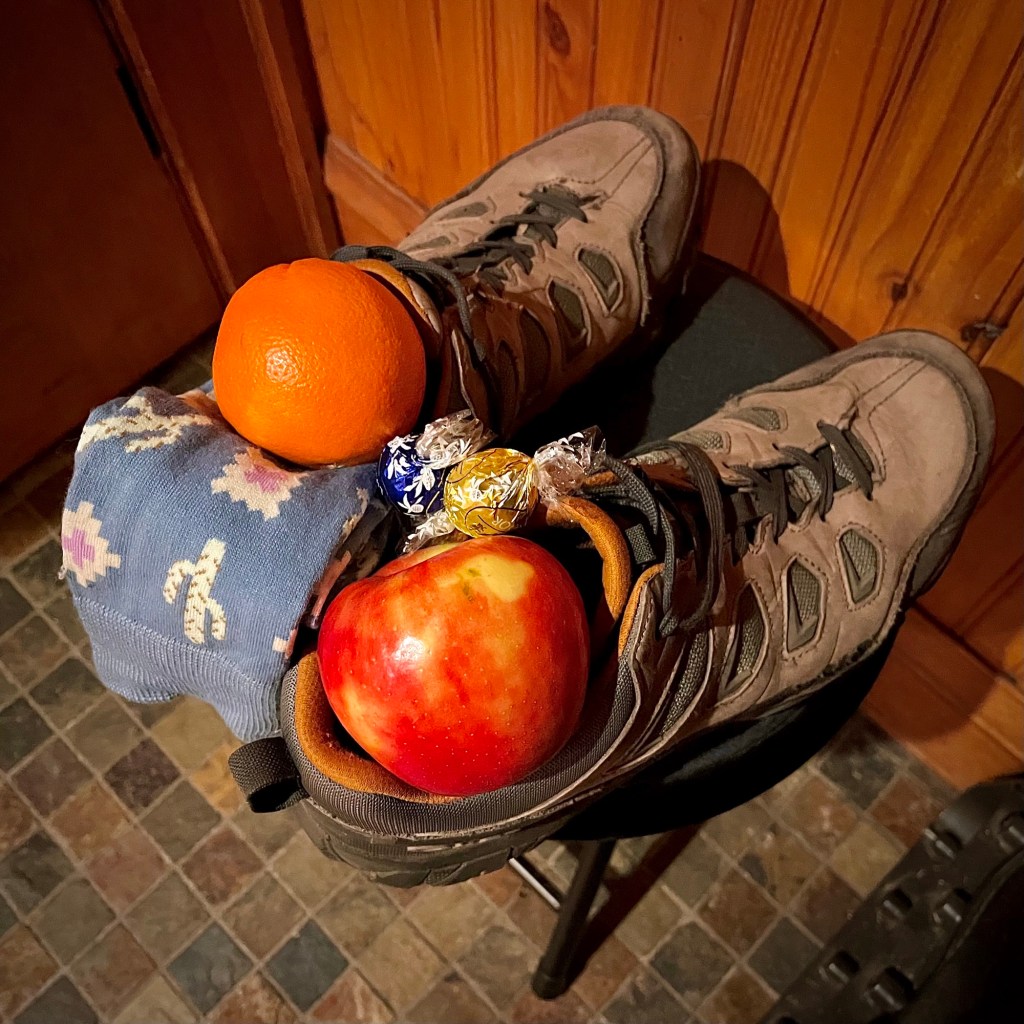
What Happened to Santa Claus?

Today, December 6, was wonderfully festive in our family when I was a child. St Nicholas Day — unpretentious, simple, even spare!  Unlike Christmas, St Nicholas Day always caught my siblings and me by surprise, off guard!!! Why our young minds never anticipated the annual surprise is part of its mystery, magic and special joy. 

In our shoes or near the foot of our bed, we’d awaken to a small bag typically containing an apple, an orange, a few pieces of candy, some peanuts (in the shell) and either a pair of socks, gloves or something else distinguished by its inexpensive practicality!

Here is a “prayer” that perfectly captures the values and meaning we were encouraged to take to heart by the unpretentious, simple and spare custom…

St. Nicholas, protector of the poor,

Gift-giver, wonderworker, patron saint,

Renew our generosity, 

And pour afresh on us your spirit without stint,

That we, like you, might notice, might respond

And rescue those whom we’ve ignored, 

Whose plight cries out for our redress: 

Near neighbors  bound by poverty and debt, 

The out of sight and out of mind, 

The children of the poor, all the exploited, 

Those whose lives are wrecked

By others’ greed, indifference, and neglect,

Those overboard and floundering for the shore.

Help us make others merry with our wealth

And joy, like you, in doing good by stealth.

    —Malcolm Guite

Here’s what greeted me this morning. The mystery and magic endures. But, what have we done to Santa Claus?

An Elder’s Hope

First, a poem…

At the center of every crisis 
is an inner space 
so deep, so beckoning, 
so suddenly and daringly vast, 
that it feels like a universe, 
feels like God. 

When the unthinkable happens, 
and does not relent, 
we fall through our hubris 
toward an inner flow, 
an abiding and rebirthing darkness 
that feels like home. 

Dr. Barbara Holmes, “What Is Crisis Contemplation?”

As one who at 74 wants to get old well and who is consciously trying to discover what being an elder looks like, I consequently want to honestly embrace my mortality and remain curious and deliberate about my dying (spoiler: it’s a process and not just an event).  That’s where Holmes’ poem comes in. I’m intrigued by the second stanza and drawn to the potential of death as a life process, an “inner flow.”

My rumination has been enriched by a response shared by a friend with whom I did hospital chaplain residency a dozen years ago. She wrote: “Amen!  Ask: Is this darkness, darkness of the tomb? Or darkness of the womb?”  

Yes, death certainly “does not relent, and we fall through our hubris” into a dark tomb — echoing all those creedal formulae we babble unwittingly throughout our lives… “he descended into hell and on the third day…” And, yet, as Christians we proclaim this to be the darkness of the womb — “an abiding and rebirthing darkness that feels like home.” 

As we age, and especially in our elder years, we recognize this growing awareness not so much as a “profession of faith” but as an experiential foundation for our burgeoning hope!  As elders we transition from being persons of naive, doctrinal beliefs to those living with a reassuring, alluring hope we increasingly experience, at last, as HOMEcoming!

A Christian Nation

While brushing my teeth I often ruminate on whatever is upper most in my curiosity at that particular moment. This morning it was about the contention that America is a Christian nation. What even does that mean?  What ever does this imply for for Jewish, Muslim, Hindu Americans?

About the time I was warily navigating around a recent root canal, the Lord’s Prayer came to mind. God, how many times in my 74 years have I rattled off those words?  “…Thy kingdom come, Thy will be done” grabbed my attention. What might this even mean if we actually were a contemporary Christian America? You know, that “…on earth as it is in heaven” part!

Some ask, “Have you accepted Jesus as your personal Lord and Savior?” Isn’t it at least consistent, if not required, that we ask whether Jesus is accepted as our national Lord and Savior?

Here’s the rub… do we go deep enough with these questions?  Are Jesus’ concerns and associations our concerns and associations?  His mission, His values; our mission and our values? Quoting the prophet Isaiah, He clearly told us what he’s about… 

“The Spirit of the Lord is on me,
    because he has anointed me
    to proclaim good news to the poor.
He has sent me to proclaim freedom for the prisoners
    and recovery of sight for the blind,
to set the oppressed free,

to proclaim the year of the Lord’s favor.” (Luke 4)

Are we on board? Or, does the acceptance of Jesus in our lives function as a “salvation insurance policy” collectible after we’re dead? Perhaps a Baptist preacher said it best, “Sometimes our faith can be so heavenly minded it’s no earthly good!” Clearly, the pastor wasn’t preaching Joel Orsteen’s “prosperity Gospel” primarily used to rationalize obtuse wealth and a self-serving contortion of divine favor! 

Here’s my honest observation… “Christian” too often appears as an adjective we tag onto whatever we want to justify or to “baptize” what we want to believe. If this is not so, we who would profess Jesus as our Way, Truth and Life must subject ourselves to honest self scrutiny to legitimate our claim. This isn’t Liberal or Conservative, Left or Right, Democrat or Republican! It’s simply Christian!

We must critically judge whether we can muster sufficient evidence to validate that we as individuals, families, congregations — as a nation — merit the name Christian.

Here’s this 74 year old’s reluctant assessment… Capitalism is actually our religion, consumerism our currency of grace, materialism our standard of virtue and money our God!  Are we willing to consider whether our prayer is more accurately, “My kingdom come, my will be done on earth and in heaven.”?

Jesus sets a truly high bar for any claiming the appellation “Christian”. He explicitly gives us the ultimate criteria in what is our “Final Judgment”…

Then the righteous will answer him, ‘Lord, when did we see you hungry and feed you, or thirsty and give you something to drink? When did we see you a stranger and invite you in, or needing clothes and clothe you? When did we see you sick or in prison and go to visit you?’ “The King will reply, ‘Truly I tell you, whatever you did for one of the least of these brothers and sisters of mine, you did for me.’ (Matthew 25)

Again, this is not Liberal or Conservative, Democrat or Republican! It is the Scriptural litmus test for whether we and this nation are, in fact, Christian.

Rinsing toothpaste from my mouth, my eyes fixed on the mirror. A pang  of discomfort and soul searching found apt release in my spitting into the sink.  Again, staring at myself in the mirror, I commiserated with those folks who start leaving Jesus because His is a “hard teaching’” (John 6). My reflection transported me to Caesarea Philippi, “Who do you say that I am?”(Luke 9). 

Jesus begs a response profoundly more momentous than most of us are willing to fathom!

Preposterous!

Been thinking the unthinkable… what if the burgeoning number of people who describe themselves as “not religious” and a culture that no longer reflects Christian values actually reveal the precise place of the Holy Spirit’s action, desire and intentions?

We only half-jokingly mumble “it’s over” for religion as we have known it! Paraphrasing Pope Francis’ prescient observation: “Ours is not simply an epoch of change; we live in a change of epochs!” Like it or not, this is the world in which we find ourselves. There is certainly resistance and grief woven through our denial or resignation. Yet, why would we expect to find God anywhere else?

What elements of “the faith” would we want passed on? Yes, the kerygma for sure. But what form or expression does the proclamation of Good News need to take? What of current methods, structures, practices or traditions are essential, effective and deserve to be preserved? And the always more relevant question: “What’s God up to?”

Christian faith and religious expression have not always been as we’ve experienced in our lives. Imagine the rich diversity of styles and configuration of community spawned by the Reformation. Only in the nineteenth century did Rome disentangle itself from the political shackles set in place by Constantine in 313 CE.

Consider a specific example near and dear to my heart: How must Ignatius of Loyola’s revered Spiritual Exercises — composed in the 16th century at the dawn of modernity — be reformulated for a fast approaching post-modern world? Some would dismiss my question out of hand and charge me with heresy, apostasy, sacrilege, ignorance, even arrogance for imagining such a preposterous idea. But, again, “What’s God up to?”

Observing how Christianity has been transformed, even co-opted, over the centuries, who are we to say that the forms, structures and expressions of religious faith we have known, treasured and served are even suitable or relevant to whatever the future holds? So much around us is crumbling — much needs to crumble! There’s plenty of precedent for that in Judeo-Christian faith.

“Unless a grain of wheat fall to the earth and die it remains but a single grain, but…” My faith suggests that the Spirit is up to something great, grand and unimaginable! We are never left orphans. Might the self-proclaimed “not religious” actually be clearing the land and preparing soil for the seeds of faith most relevant for our grandchildren’s children? Preposterous?

“They still did not understand from Scripture that Jesus had to rise from the dead.” (John 20:9). This is the kerygma, the faith we too need to better take to heart.

To Everything There Is a Season

Hello from Ireland where I have been on a personal and ancestral pilgrimage. An image captures a mercurial grace I’ve been trying to articulate. It is of Mount Melleray Abbey outside Cappoquin, County Waterford very near my ancestral roots. On Thursday when I participated in Sext (noonday prayer) there were five monks in choir stalls. Two were clearly pushing 90! None of the others are what we would call young.

I’ve always loved the Cistercian/Trappist tradition and have visited New Melleray Abbey near Dubuque, Iowa as often as I’ve been able. As the name suggests, New Melleray is an offshoot of Mount Melleray — seven or eight monks were missioned from Ireland in the mid-1840s to establish an abbey in response to an invitation by the bishop of Dubuque.

You will recall that Henry VIII abolished all monasteries and confiscated their lands. Irish monks fled to France. After a few centuries, and with Catholicism again being tolerated in Ireland (1829), a group of Trappists returned home to establish Mount Melleray in 1832. The photo only shows a portion of a sprawling abbey campus. A train of serpentine buildings probably add an equally sized footprint to the complex. The campus is huge and immaculately maintained.

Fr Donal, OCSO with whom I spoke said they now lease out their farmland, have a cafe which is open to the public, a gift shop and heritage center. These are their sources of income. He noted that New Melleray in Iowa had recently helped them financially with the planned transformation of an old building into a hostel for pilgrims after they discovered the building was riddled with dry rot. I have no clue who is paying for the significant repairs suggested by the scaffolding in the far left of the photo.

Here’s my impression… as with Archbishop John Ireland’s determination to build the Cathedral in St Paul to be taller and in a more commanding location than the Minnesota State Capitol, I fully appreciate how important it was for the Trappists, and Irish Catholics in general, to erect a monumental edifice to make a profound statement regarding their presence and the restoration of their public practice of Catholicism in the 19th century.

But this is the 21st century. Times have changed. The practice of Catholicism in Ireland has shriveled. Thus, my further impression and belief… God certainly intends to foster the Cistercian/Trappist charism within the Church, but not as currently manifested in the “behemoth” planted in western County Waterford. When visiting and since, I felt nothing of the cloistered, contemplative asceticism I love and still find at New Melleray. Absent was any salient presence of my understanding of the rich, communal, singular dedication to God found in the Rule of Benedict; or even the vitality and joy I find at St John’s Abbey/Collegeville. What would Bernard of Clarevoux or the reformers of Our Lady of La Trappe counsel today? An ember burns. The Spirit hovers.

Loving the tradition as I do I’m left wondering, “What young person aspiring to the contemplative life of stability, obedience and conversion-of-life would be attracted to Mount Melleray today?” Not many, I am fairly confident. Similarly, I found the Abbey to be an apt expression of the contemporary Church whose tradition I love and cherish. It hovers as an invitation, a yearning — we all need to become much more humble, simple, God-centered, communal, and grounded in place/earth/creation. We need what the Benedictine tradition seeks, a thorough conversion of heart!

I talk a good talk and have noble aspirations. Yet, I like the consumer culture in which we are enmeshed and moribund Church structures I can so easily criticize, Mount Melleray Abbey stands as a symbol and indictment of me personally every bit as much as this faithful remnant of monks, the stifling clericalism of the Church or the dry rot found in so much of American culture.

Perhaps the most lingering impression and telling symbol in this photo is the graveyard lying in front of the edifice.  Finally, from death comes life!

An Inalienable Right

Happy Independence Day! That wish is expressed somewhat furtively!

Many of us are feeling frightened and anxious on this Fourth of July, 2023. It seems that women, Black and brown people, and those of us who know that sexual orientation and gender identity cannot be squeezed into a stark binary of male/female have taken some really tough hits this past year — hard fought rights we began taking for granted have been attacked and swept away by six Supreme Court justices.

Today we may go to the park to watch fireworks. We may host family and neighborhood picnics of burgers, potato salad, corn on the cob and down watermelon leaning forward to accommodate the slobber. We may feel proud and self-congratulatory — if somewhat naively — in claiming to live in the freest country in the world. We may even hear patriotic platitudes from the media reminding us, “We hold these truths to be self-evident, that all men [and women] are created equal and endowed by their Creator with certain inalienable rights.”

Is this truly what we believe? Is it truly more than a bromide? Are we willing to defend such bold, noble proclamations? What precisely do we believe is “self-evident?” — some self-assured binary of right and wrong, male/female, yes/no, black/white, us/them certitudes? Such bald assertions just feel too secure, defensive and self-serving in light of the ennobling rights of life, liberty and the pursuit of happiness lavishly proclaimed in our Declaration of Independence.

Many ask me, “Richard, how do you remain so resolutely Catholic?” Many more of us are asking, “Can we remain living in a MAGA nation?” Well, the flippant but equally accurate answer is that I’ve been given a remarkably good education in theology and Church history. That includes a masters degree in Political Philosophy and I’ve taught American Government. Another reason is that I’m old! — all I need is to look back at the America or the Catholic Church into which I was born in 1950 and where we are in 2023 — Wowzer! Change happens, dramatically over time, but not without jarring setbacks at other times!

Much has been made in religious circles about how devout Catholics like Joe Biden and Nancy Pelosi make sense of their responsibilities as President or Speaker of the House. They demonstrate how I, and other people of committed faith, escape that most subtle and sinister of binaries — that I cannot be a patriotic American (in defense of the rights so nefariously compromised in the last year) and a committed Catholic equally proud of my religious identity.

As a person of faith and a patriot, I do believe that all men and women have been endowed by their Creator with certain inalienable rights. And among these are life, liberty and the pursuit of happiness. Yes, that is why people form governments — to protect these rights and provide for our common welfare. That is why the bedrock of Catholic moral teaching — as you will see being played out in the throes of contemporary America — is the supremacy of the well-intentioned and well-informed individual human conscience!

Admittedly, it’s tough! But it’s how I keep the faith — in America and in my Church.

Give It Up!

Over my soon-to-be 73 yers I have had to let go of many friends, careers, family, cherished possessions even understanding of my identity. I’ve shed a few unhealthy addictions, more than a few preconceptions, even conceded — reluctantly — that I’m not always right. Cruising deeper into my eighth decade of circling the sun, spontaneous body aches or episodes of vanishing memory suggest a lot more yielding, giving-way, mini-deaths lie ahead.

Lent 2023 gave me pause. The forty days just past could not have been more different from prior religious practices and disciplines. Probably lethargy. Perhaps a deeper integration of the spirit rather than the letter of the law? A sign of maturity rather than rote obedience? I wish!

Nothing expresses this conundrum better than my largely discarded, dismissed and devalued Lenten practice of fast and abstinence. How strange that seems. Catholic discipline excuses those of us over 65 from the obligation to fast or abstain from meat. Early religious formation explained that this exemption was to preserve the health of the elderly.

Now a self-proclaimed old-timer, I beg to differ! I have come to believe that by the time we merit senior status spiritual practice is either cruising along well on auto-pilot or its truly inconsequential. Whatever, at my age, I still bristle when anyone tells me what to do (didn’t I just say that much more letting go and mini-deaths undoubtedly lie ahead)!

A bright flash pierced my inattentiveness when I happened upon these words by Judy Cannato this week, an author of whom I had never heard:

Even little resurrections that come after choosing to die to fear and egocentricity release the Spirit. When we engage in a lifetime of death and resurrections as Jesus did, we become ever more empowered to do the work God asks us to do.

How humorous that I’d be given this awareness during Easter Week! It sure would have enriched my experience of Lent 2023. Or, would it have?

I’m embarrassed to say, with all the Catholic heritage and sophisticated theological education I’ve been given, I have never really made the connection between fasting/abstaining as a mini-expression of the Creator’s invitation — even when my desire is feeble — to die with Christ that I might rise with Christ, not one festive day in the not-so-far-off future but daily, if ever, in the here and now.

Okay, perhaps that was always the point and was there all the time. Honestly, it never really sunk in! I simply didn’t recognized any efficacious connection with empowering me to do God’s work in the world nor appreciated how fasting and abstaining offers practice for sharing in Christ’s resurrection.

Too many church disciplines and pious practices seem so dismal, hardly more than a regimen to earn our own salvation. How ironic that this renewed awareness was given during Easter Week. Obviously, it’s time to take these spiritual siblings from the shelf, dust them off from years in storage and revive them as efficacious practices for disposing us to God’s grace.

Clearly, Lent 2023 yielded its own fruit despite my inattentiveness. And today, Friday in the Octave of Easter, a weekly day of abstinence might very well be a good place to start — no, not Lent, but starting with the Fridays of the Easter season! Being a vegetarian should provide no out! Excuses and explanations must give way to desire and generosity. For example, I could well substitute abstaining from sugar as an alternative! Creativity welcomed.

If my years have taught me anything it is that time is insistent. There’s so much of which we must let go, yield, give up. Occasions cascade, options narrow. God knows we need the practice.

From this renewed perspective and with only self-imposed obligation, I now choose to abstain, and fast!

________________

Judy Cannato’s fuller reflection is within a Daily Meditation from the Center for Action and Contemplation. https://cac.org/daily-meditations/watchful-for-resurrections-2023-04-12/

The Day After

So, it’s the Monday morning after Easter. I’m still mulling over the question, “So what has changed?” Does our celebration of Easter make any difference? I’m concluding, “No, for most it doesn’t! Except for kids who’ve come to look forward to it as a mini-Halloween — Easter baskets just being a smaller version of their Halloween haul.”

I do not mean that as a crotchety old curmudgeon! Rather, it points to the importance and urgency of the Spiritual Exercises of St Ignatius, founder of the Jesuits. I’ve come to believe that unless people have some sort of a genuine personal experience of the passion and death of Jesus, even the liturgical celebration of the Triduum remains an exercise of pious wishful thinking regarding a reward in the hereafter.

Far too many may even regard going to church on Easter as a pious social practice at best or, at worst, as an obligation for earning heaven. I’m not saying the Spiritual Exercises are the only means to open us to the transforming grace of encountering the Risen Christ! It is simply an especially well honed instrument for disposing us to such grace. When well executed and fully engaged, the Triduum liturgies will also dispose us to the same.

But this morning I’m still taken by what I shared yesterday…

Life is changed, not ended.” echoes through these events and is evident in the world around. But how? How is life — the whole creation — different from yesterday? Easter Sunday cannot be a final, singular, historic event. So much suffering, injustice and death attest to that. Rather change, transformation, resurrection, salvation, reconciliation, peace, joy, justice, pulses within and radiates from all that shares being. Resurrection is now, here, today if anywhere, ever!

Gerard Manley Hopkins captured it best when suggesting Easter as a verb. If yesterday, if the Triduum, means anything at all it is that Christ “Easters” in us and throughout all creation. That is the only faith that can nurture and sustain us within a world of war, death, suffering and injustice! Christ “Easters” in us, or not at all! We are to be an instrument and locus of that “Eastering” in our world.

Otherwise, we are simply about something as fantastical as the Easter Bunny.

Eastering

This morning, mulling over the meaning of this day from Washington, DC…

I arrived last evening to be part of mourning the loss and celebrating the life of my niece’s husband (56, died of a massive and totally anomalous brain bleed).  Just saw James Martin’s FB post the Tom Stegman died yesterday, appropriately on Holy Saturday (sublimely perfect — he was not the Christ but shared in such life and love so intimately).

Life is changed, not ended.” echoes through these events and is evident in the world around. But how? How is life — the whole creation — different from yesterday? Easter Sunday cannot be a final, singular, historic event. So much suffering, injustice and death attest to that. Rather Easter, transformation, resurrection, salvation, change pulses within and radiates from all that shares being.

It is now, here, today if anywhere, ever! May we be wrapped in the Mystery of it all.

Finding Our Way

Irishman Padraig ÓTuama, host of Poetry Unbound, wrote something so wise, so consoling, so true-to-my-experience that I simply had to share it here:

During the retreat last week, I took a few walks. One afternoon, Sean, a man I’ve met and kept in touch with from other events, asked if I wanted to go on a hike. Yes. The pathway was covered with gorgeous autumn coloured leaves. Sean knows those pathways well, though, so — mostly — we were able to find the way. But even he was stumped by the way the fading light made old pathways seem unfamiliar. I trusted him, as he laughed at himself when he felt wrong-wayed. I liked his guidance that even though he didn’t know the way, he knew a general direction. We made it back.

I spent years of my life looking for the way, thinking I might find it in some small section of religion. Or, when that faded, thinking I might find it in some small particular practice. The desire wasn’t the problem, the imagination was. The imagination that there was only one way. What I see, over and over, is that the way is made: with failure, friendship, desire, thwarted desire, achievement, limitation, justice, reparation, the long ache of wound, art, ambivalence, and amazement. There is no, the way. There are just the ways we get through.

I encourage you and others who are hungry for wise insight regarding this adventure we call “life” and down-to-earth inspiration for finding our way(s) to check out Poetry Unbound and consider subscribing. Here is a link to Pádraig Ó’Tuama’s complete reflection from which this selection was taken: https://poetryunbound.substack.com/p/the-ways-we-get-through?utm_medium=email